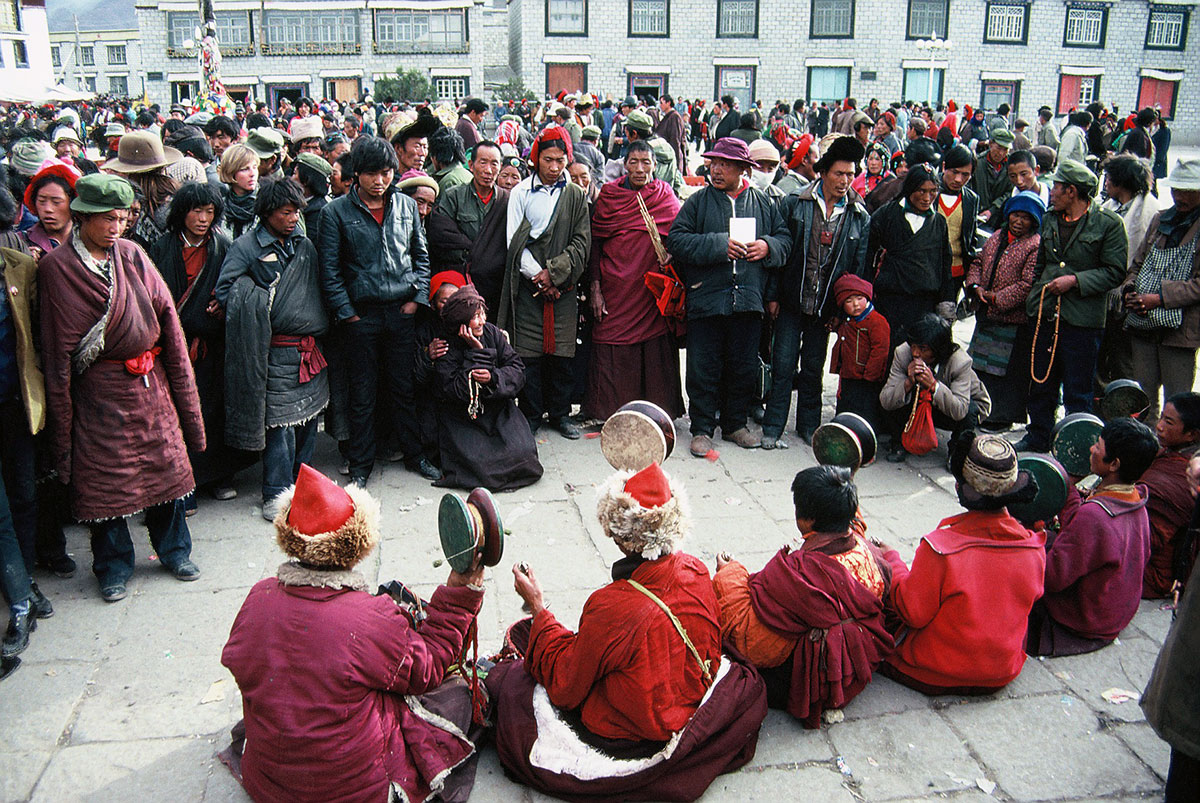
Barkhor Square, in front of Jokhang Temple 2026.04.03 / Essay
I arrived in Tibet on borrowed time — and borrowed money. One hundred dollars from a Japanese traveler I’d met on the road, just enough to make a last-minute detour before flying home. All I had left in my bag was two rolls of Fujichrome RDP and one roll of Kodak Tri-X.
I flew in from Kathmandu. There was no terminal building then — the plane simply touched down on an open field. Three immigration officers in pale green uniforms came out to meet us, and once they waved us through, there wasn’t a bus or taxi in sight. For a moment I just stood there, uncertain. Then I spotted the Holiday Inn shuttle — the only hotel in Lhasa that stocked oxygen canisters — and managed to talk my way into a ride toward the city center.
Out the right window, a lake appeared, an almost impossible turquoise, the color of the sky pressed into water. Then, far ahead in the distance, the Potala Palace came into view — small at first, rust-red and white against the vast plateau. I finally made it. Äi0Ten days earlier I’d tried to enter overland and been turned back at the border.
The hotel lobby was warm, and I let myself enjoy it for a while, knowing I’d be leaving that comfort behind soon enough. I moved to a cheap guesthouse near the Jokhang. Outside, the sky was an almost physical blue, the air glittering as though the light itself had crystallized at altitude. The boulevards had been newly laid out and planted with ginkgo trees in vivid lemon-yellow; PLA soldiers directed traffic at the intersections. The area around the Potala looked nothing like the photographs I’d grown up with. I had the feeling I’d slipped in just at the hinge point — the last moment before everything changed.
As I walked toward the center of the old city, toward the Jokhang — the spiritual heart of Tibetan Buddhism — the atmosphere thickened around me. Groups of pilgrims who had walked hundreds of kilometers to reach this temple moved past in full prostration, their bodies striking the earth with a sound that rose above the dust they stirred. I turned down a narrow alley thinking it might be a shortcut, and found myself inside a Tibetan market known as Trom SikhangÄi0. Rough-cut yak meat, yak butter sold by weight, vegetables piled on handcarts, fried sweet pastries, flat Tibetan bread — stall after stall pressed close together. Beyond the market, the lane opened into a row of shops selling ritual objects, jewelry, and souvenirs. This whole circuit — the covered lane ringing the temple and the square in front of it — is called the Barkhor, and I came back to it every day.
The Barkhor was endlessly alive. Pilgrims and monks, wanderers and traders, people from a dozen different ethnic groups all moving through in their own distinctive dress. Tibetan women laden with turquoise, coral, and amber set in silver and gold. Broad-shouldered Khampa men with scarlet cords wound into their hair and knives hanging at their hips. Almost every hour, somewhere nearby, monks would begin to play or chant — a sudden, impromptu performance. I would sit beside a monk who seemed to read sutras under a canvas awning every morning, or settle next to a nomadic family, watch the crowd pass, and run toward whatever was beginning.
I shot the color film carefully, frame by frame. When I was down to five or six exposures, I loaded the last roll — the Tri-X — into my telephoto body and headed back to the Barkhor. At 300mm, people rarely noticed the camera, and their expressions stayed unguarded. But something else happened as I worked with that lens: looking through a long telephoto, I began to sense things I hadn’t been able to see at wider focal lengths. An expression held on the surface, and beneath it, something else — a feeling held down, contained. Something that had gone quiet in me during the bubble years in Japan. A wish that was elemental and unadorned.
It was only watching these people that I felt the autofocus click into alignment — not mechanically, but in the deeper sense. The Barkhor was a place where that kind of longing ran in circles, worn into the stones by ten thousand feet.